_edited.jpg)
How to be present, as a mom

Once I was walking through Costco with my son in the wrap, he must have been 8 weeks old. I was barely upright, surviving and hanging on to sanity by a thread. An older woman stopped me. She was gushing - “Oh how amazing! ENJOY IT!. Just ENJOY this time. It goes SO FAST!!”. In my struggles, I just wasn’t there. And her well meaning advice only landed in me feeling guilt and even shame that I must be doing it wrong to be having a hard time. So not only was it hard for me, but the hardness was compounded by pressure to do it better. This is so so common. (I will revisit this topic later of anticipating unasked for advice, it’s a very common experience of pregnancy and early parenthood.)
A parenting maxim often shared is “the days are long but the years are fast”. We know that it is fleeting, somewhere in our bones and our memories, we KNOW how precious the moments are. But dang if they don’t seem to drag on.
And knowing how fast it goes doesn't automatically snap us into being more present.
"Be here now.” “Live in the moment."
"Stop and smell the roses".
Easy to say. Harder to do when your brain is running seventeen tabs and your toddler is asking you the same question for the fourth time.
So what does presence as a mom actually mean? How does one actually be present?
And more importantly — can it be learned?
What is Presence?
You'll hear it many times as a mom: "Enjoy this time with them!
IT GOES BY SO FAST!!"
While joy might be the goal, along with all the not-joy, presence has to come first.
Joy is like a buttefly that may land on you when you're present.
We say “presence”, in our English language in American culture today, implying a bunch of meanings.
Not being lost in thought. Presence means being aware of what’s happening around you right now, without getting absorbed in your own train of thought, or overthinking. Your mind has thoughts, but they don't consume all of your attention; you stay aware of your physical body and the outer world. “Out of your head and into your life”.
Being there with others. Presence in an interpersonal context means really being there with someone: giving them your full attention, actively listening, and connecting without distractions or letting your mind wander to other things. It’s about staying engaged and focused on the person in front of you. We’re present WITH them, we’re truly “there”.
Being ON. In leadership or work settings, presence often means "executive presence"—the ability to grab attention, show confidence, and influence others just by staying focused, engaged, and centered in the moment. It’s about how you carry yourself and how others respond to your energy and focus.
Flow. Classic flow is defined as a sense of effortless productivity and deep satisfaction. In flow, we are locked in. Our attention is not divided, and we perform at our best without being distracted by self-consciousness. We take care of what arises. We are “in the zone”. We are fully engaged.
Intentionally enjoying life. Slowing down and savoring what is in the present. This presence is about choosing to be here, now, with a focus on the positive aspects of life and the people we love. We appreciate the little things. We choose to see that life is good. We stop and smell the roses.
Finally, there is a spiritual element. Presence is often seen as feeling connected to something bigger, whether that’s nature, other people, all that is, the divine, universal energy, or your higher self. It’s also about living fully in the moment, aware of that spiritual connection as you go through life. We have a bigger perspective.
Why be Present? For Mom and the Kids.
The way I see it, presence contains all of these.
Being present means having our attention zoomed in to what’s actually happening right now.
We are engaged in what we’re doing. We’re noticing what we’re sensing. We’re responding to incoming demands in an appropriate way. We're choosing what we give attention to.
And it just so happens that the present moment is where joy arises.
There are two basic reasons to get more present:
Presence is for us: Being present helps us feel more calm, centered, and aware. Joy naturally arises when we focus on the moment at hand, instead of letting our minds race ahead or linger in the past. Presence helps us live more fully, right now.
Presence is for others: Being present also allows us to show up better for the people we care about. When we give someone our undivided attention, we offer them respect, empathy, and deeper connection. In relationships, presence signals that we’re truly there—listening, caring, and engaged—which strengthens bonds and creates a more meaningful connection with our babies.
In both cases, presence is a gift, both for ourselves, and for the world.
Presence gives birth to some of our favorite human experiences: joy and connection.
4 Ways to Practice Presence
First, I encourage you to reflect about what presence means to you. Do you resonate with any of the above definitions?
Try observing yourself, as if from the outside, as you interact with friends and family and go about your day. Reflect or journal about what you find, such as:How present are you at different times throughout the day?How do you know? What does presence give you? What does presence give those around you? What do other peoples’ presence give you?
After reflecting on your baseline, give presence practice a try. Read over these 4 practice ideas now, and sprinkle them into your life throughout this week and the weeks to come. There’s a lifetime of practices here. Just take it slow and pick one or a few that sounds helpful and doable for you.
Play, and experiment, and notice how it affects you and those around you!
Presence Practice #1: Play your Way to Presence
When I originally wrote this piece, this idea was last. I changed it to make the game front and center, because I want you to try it. Let me know how it goes!
This one involves asking yourself a question, which gets your right brain creative juices flowing. Questions contain the power to wake you up, fast.
Finding what’s new is a game. Here are the rules:
Objective: To more deeply be present with what your current experience is actually like.
How to Play the Game:
Look around you, wherever you are right now.
Ask yourself some version of the following question:
What do I see that is different than what I expected?
What did I not know was here?
What can I find that is new here, when I really observe?
Winning:
You win the game when you find something that genuinely surprises you.
Example of Play:
Example 1 - Say you’re driving. You start the game. You look around - trees, trees, road, sky, other cars, yellow lines, same old house, same old other house… Nothing new here. Your brain expected all of this. You keep looking. Finally, you spot the color of the sunset on the underside of the clouds in your rearview mirror. A slight “wow” registers. You didn’t know that exact peach hue was there. Congratulations, you win! 30 seconds later, you notice a small handmade stone wall on the side of this road you’ve travelled a thousand times that you never noticed before. Bonus: you’ve activated the noticing and appreciating circuitry in your brain.
Enjoy your prize - a heightened state of presence.
Example 2 -
I challenged myself to find something new while I was doing the most boring of tasks this morning - unloading the dishwasher. It was hard. There was nothing new in my kitchen. Old papers that needed me later, old floor, old cabinets and dishes; all the same old, same old. So I checked inside. New feelings, thoughts, and sensations can be found within, too. Nope, just feeling like normal me today. The newest most interesting thing in the room was my daughter sitting at the table reading, swinging her legs. And I realized she was singing a new song, that I didn’t know. She was making it up, happily letting her voice soar, and adding whistle accents. She has a gorgeous voice, but the truth is that she is often an absolute grump in the mornings. I almost missed her pure childlike delight and morning glory!!! This brought me into my day with so much presence, and a ripple of pure joy.
Example 3 - The other day while sitting at a middle school field hockey game, I played Finding-What's-New, and completely bombed. I persisted for the whole fourth period (my daughter was on the bench!), and the only new and different thing I could spot in my field of vision was some colors of cleats I didn't know existed.
Even though I lost the game, I still won the prize for participating.
The after effects of playing the game are real. While driving away, I felt extremely tuned in to my daughter in the car, and the stories she was telling me about her day.
My brain was primed into a different mode of heightened awareness, and I was picking up more details than usual.
With repeated play, the ability to use this Present mode strengthens, like anything that is practiced.
Recommended Variation:
This is a fantastic inner game to play when you are with your children, of all ages. Or spouse, or friends, for that matter. When we shine our light on the real world and on our real humans that we love, we illuminate details and nuances in them that we would have completely missed otherwise.
Advanced play:
Variation 1 - Same rules, but play when you are stressed, tired, or in pain.
Variation 2 - Try the same game with your sense of touch (so good) or hearing.
How it Works:
“Your brain focuses its spotlight of attention continually and automatically, and often you’re unaware that it’s happening.” ~Lisa Feldman Barrett, mother, neuroscientist, author
The brain loves what’s novel. When you do find something newish and interesting, that will give your hungry brain something to more effortlessly put attention on in the here and now.
Your brain is always subconsciously finding what’s new and most important (read: threats or resources). If a lion bounded into your kitchen, or if a cockroach scurried across the floor, YOU’D KNOW. But often the precious novelties of life are too subtle to be heard over the din of our busy minds and stimulant rich environments. We have to tune in to a different channel if we don’t want to miss them.
Our brains think we know a thing. Lisa Feldman Barrett’s research shows us that the brain is a predictive machine; it doesn’t see exactly what is there, it sees just enough to sense the pattern and fill in the gaps, while relying on our history to predict what will happen next and mobilize resources to deal with it. Remember the invisible gorilla experiment? People counting basketball passes completely miss a person in a gorilla suit walking through the scene. The same mechanism applies to your everyday life. If the environment displays boring, status quo - nothing new, threatening, or to eat or mate with - our brain doesn’t waste energy giving it attention.
Prediction is efficient. The brain conserves a ton of energy to drive to your destination with no conscious recollection of how you got there.
That's why it often feels so hard to be present. Many real life ordinary moments do not deliver that easy novelty and feel-good dopamine hits that your phone is designed for. While being a mom contains a million wows and so much change that it keeps us busy, that's not always enough to hold our wily attention. The present moment has to be sought. Presence without deeper hunting feels boring.
Finding-what’s-new challenges your brain's predictions, and checks its assumptions.

OK brain, you think you know what’s going on? Let’s check in and see if you really are getting all of this. Chances are high that you’re not. And chances are also high that what’s being glossed over is something that is beautiful, amusing, or interesting.
We're going for a walk outside, and we just see: trees. When playing the find-what’s-new game, I look up and around, actually observing the trees more deeply. I always find shapes, colors, textures that I didn't expect. The world becomes magical and wondrous.
The same is true for people, to a higher level of complexity. Same with your pets, plants, and anything alive, anything part of nature; there's always subtle novelty, if you take the time to seek.
I think this is how young kids live. They're always in this crisp state of mind of truly seeing. It's just part of our human design for unique growth and development. Curiosity to pick up what's new and different is necessary for learning. It's only as we get older and more used to the way things are that we tend to tune it all out and go into our heads and rumination instead. I think, being there, in that perspective, in that seeking frame of reference, keeps us young and childlike.
That's one of the reasons that people love kids so much, because the world springs fresh to them, and we get to experience it as fresh again when we’re with them.
Brandi Carlile sings in ‘The Mother’ that all the wonders she has seen will be seen a second time through her daughter’s eyes. Finding what’s new is seeing with artist's eyes. This must be how a painter observes the world, to see what's actually there, to see beyond the preconceptions, and really see the light and the shadow.
Maybe more importantly, seeing with those fresh eyes helps us to more deeply connect. You can imitate your child in that pure-eyed state of mind. And you can give them a gift of meeting them there in a similar state that they're in.
And the possibilities for application are endless.Do you actually know what your partner's voice sounds like? I mean, I know you recognize it, and have heard it a million times, but if you go into it more deeply, is there an experience of it that's unspoiled? After the first bite of ice cream, it's just ice cream. You're just gobbling it up. Unless…
Finding-what's-new is really about delight. It’s about appreciating something to the max. I don’t know about you, but that’s how I want to be with my kids.
Pregnant? There's one more presence practice only inside the Motherflow Journal that's specifically useful for the newborn period. It might be the most important one.
Presence Practice #2: Nervous System Regulation
Good news: You’re already doing it! If you’ve been reading here, you know the nervous system science. Nervous system regulation is training for presence. If not, try this free 4 week email mini-course.
Awareness of your nervous system state and small actions to bring it back to baseline don't require long meditation sessions. Micromoments matter for overall stress regulation, and your level of presence!
Check in with yourself frequently to notice your nervous system state.
Create your own personal Nervous System Protocol - play with this, develop it, and use it in different settings and states, from the routine to the stressful.
Use techniques throughout your days: the physiological sigh, stretches, smiling, chewing well, grounding into your body and your senses.
Check out my master list of evidence-based nervous system regulation techniques.
Presence Practice #3: Put attention on breathing.
My guess is that if you asked people at random how to be more present, many of us would instinctively say — “Breathe”.
Any time we move attention to our breath, we get present. Watching or slowing the breath is a great disruptor of habitual automatic thought patterns.
One slow breath can make a world of difference to your state.
Here’s a few ideas to have fun attending to breath.
This is the world’s shortest meditation: Just follow one breath. That’s it. Just watch.
Take one conscious slow breath. Make it a few. Intentionally slower breathing settles our nervous system, mind, and emotions, allowing us to be aware of and engage with what’s going on around us in this moment.
Wear a beaded bracelet, and take it off and breathe with the beads. In ---- hold one bead ---- out, move to the next bead --- and so on, around and around. This is a favorite of mine and I wear beaded bracelets just for this purpose.
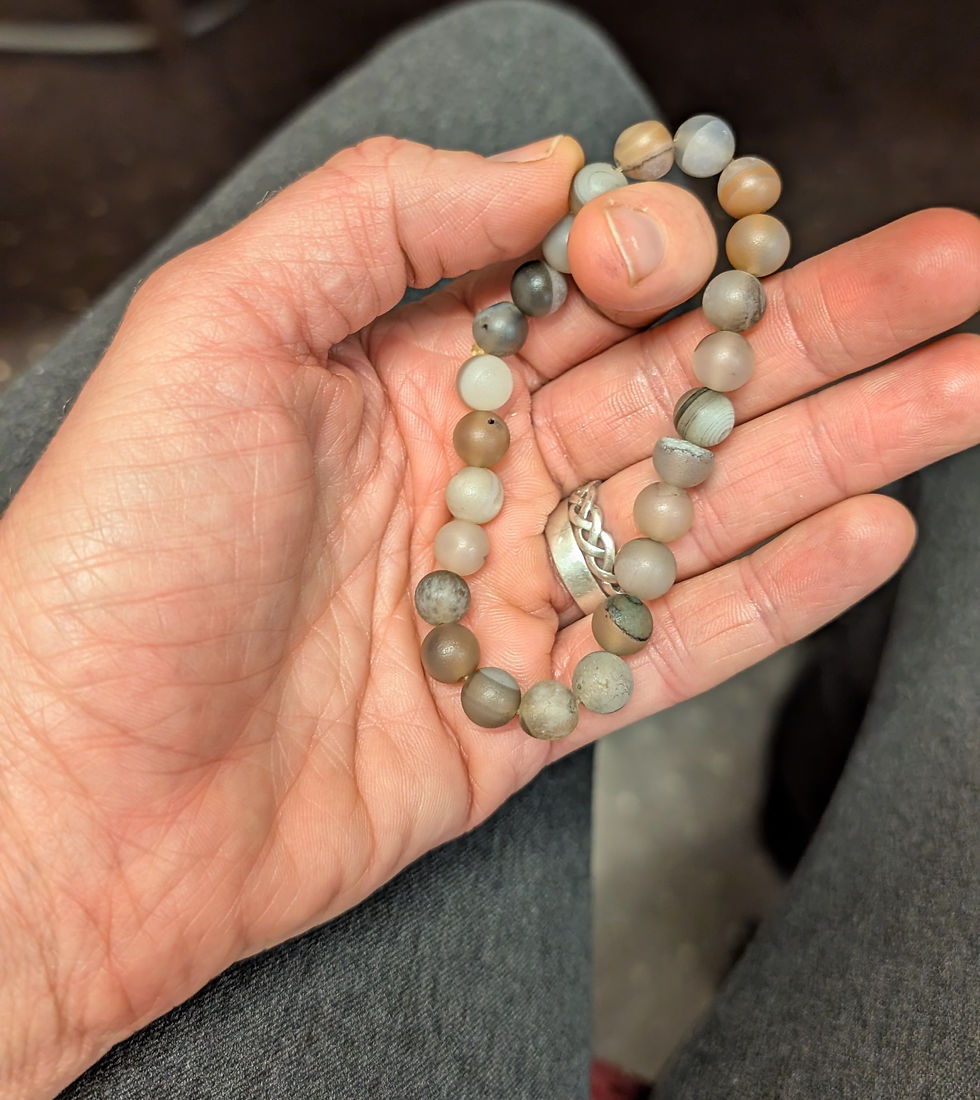
Not just a bracelet, but a sanity-saving device!
Presence Practice #4: Sense your inner body
Sensing “Inner body awareness” was made popular by Eckart Tolle’s Power of Now. By tuning into inner aliveness, you move away from overthinking and connect more deeply with your physical sense of being.
This is a good one if you struggle with being stuck in your head.
How to do it:
Close your eyes for a moment and try to sense as much as you can in your hands.
Notice tingling, aliveness, and all sensation. After a moment, do the same noticing in your feet.
Expand your attention to try to feel the aliveness in your whole inner body in this way.
Open your eyes and try to keep some portion of your attention in your inner body.
Return to sensing the inner body whenever you remember throughout your day.
To be alive is to be a witness.
Presence is just remembering to see what's actually there.
Thank you for reading, and let me know how presence affects you and your kids!
~Anna
Presence is a skill, and it can be learned before your baby arrives. The Motherflow Pregnancy Journal walks you through the practices that prepare your mind and heart for the most important season of your life.


